
Does AI Pick You? Inside the Free Leaderboard of What ChatGPT Recommends
Does AI Pick You is a free, open-source leaderboard that asks ChatGPT the questions buyers ask and tracks which products get recommended. How it works, inside.
On this page
Somewhere right now, a founder is asking ChatGPT "what's the best form builder for a solo founder?" and buying whatever it says. That conversation is invisible: no search console, no keyword tracker, no ranking report will ever show you whether your product was named or skipped. An entire distribution channel is deciding winners in private.
Does AI Pick You? exists to make that channel public. It is a free, open-source leaderboard that asks ChatGPT the questions real buyers ask, records which products actually get recommended, and publishes the results every month. Full disclosure before we go further: it is built by Brian Millot, the founder of LaunchIt, so read this as a first-party introduction with the reasoning behind it, not an independent review.
What Does AI Pick You? actually is
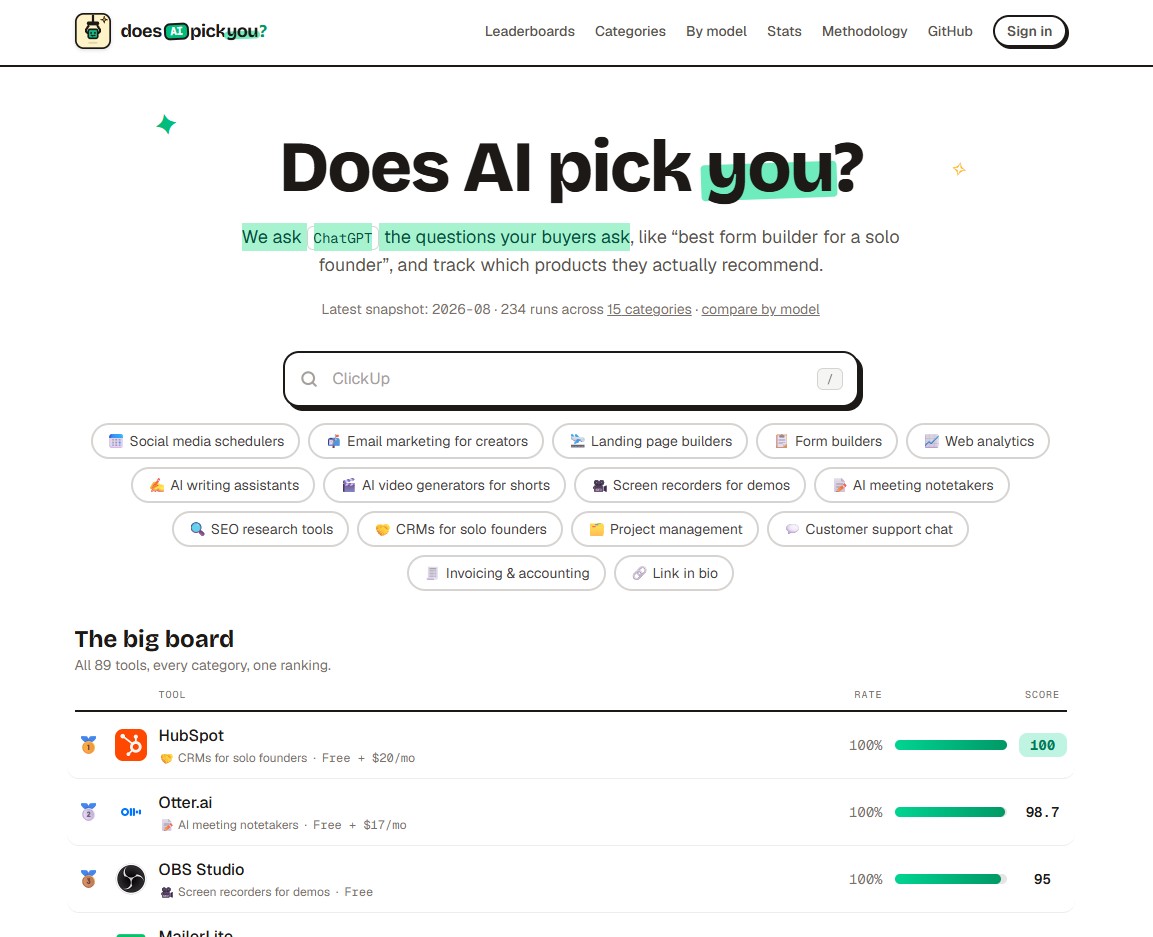
The idea fits in one sentence, which is the site's own tagline: it asks ChatGPT the questions your buyers ask, like "best form builder for a solo founder", and tracks which products get recommended. Concretely, the current version:
- Tracks 89 tools across 15 categories of everyday business software: social media schedulers, email marketing for creators, landing page builders, form builders, web analytics, AI writing assistants, AI video generators for shorts, screen recorders, AI meeting notetakers, SEO research tools, CRMs for solo founders, project management, customer support chat, invoicing and accounting, and link-in-bio tools.
- Publishes a visibility leaderboard per category, scored on how often and how prominently each product appears in the AI's answers.
- Marks the painful bottom of the table honestly: tools that never get mentioned at all sit at 0% with a ghost emoji. Invisible is a real position, and seeing it is the first step to fixing it.
- Takes a monthly snapshot that is never overwritten. The history is the point: you can watch recommendation share shift as models update and as products earn (or lose) their place in the answers.
- Costs nothing and hides nothing: free to use, open source under the MIT license, with a public methodology page.
How the tracking works
Ranking AI answers fairly is harder than it sounds, because models do not answer the same question the same way twice. The methodology deals with that in a few specific ways.
The prompts sound like buyers, not like marketers
Six prompt templates run across every category, and they are deliberately phrased the way real people type, not the way vendors wish people typed:
- "best {category} for a solo founder"
- "cheapest {category} that is actually good"
- "alternatives to {leader}"
- "what should I use instead of {leader}? I want to stop paying"
- "best AI-powered {category} in 2026"
- "recommend a {category}, I have a small budget and no team"
Notice what these have in common: budget pressure, switching intent, and specific context. That is what buying questions actually look like in a chat window, and it is exactly the framing where challenger products have a real shot at being named next to incumbents.
Scoring that rewards being named first
Each prompt runs three times to smooth out the randomness in model answers. Every product mention is scored by position: first mention earns full weight, and weights taper down to 0.4 for sixth place and beyond. The visibility score is the weighted mentions divided by total runs, on a 0 to 100 scale, so a score of 100 means the product was the first name out of the model's mouth in every single run. Mentions are counted with exact word-boundary matching against a curated alias list per product: no fuzzy matching, no generous partial credit.
Honest limitations, stated upfront
The methodology page says it plainly: model answers are nondeterministic, and multiple runs narrow the error bars without eliminating them. API responses also differ from what a consumer sees in the ChatGPT app, where web search and personalization shape answers. That gap matters, and pretending otherwise would make the data less useful, not more. Treat the leaderboard as a consistent, repeatable measurement of the model's baseline preferences, not a perfect replica of every user's chat.
What the early data shows
A few patterns stand out in the first snapshots, and none of them are comfortable:
- Incumbents dominate the top. Household names like HubSpot and Otter.ai sit at or near 100%, meaning they are recommended essentially every time their category comes up. Model training data is full of them, so the answers are too.
- The middle is surprisingly open. Below the giants, recommendation rates fall off fast, and products with strong niche positioning show up on specific prompts (the "solo founder" and "small budget" phrasings especially) even when they lose the generic ones. Specificity is the challenger's wedge, in AI answers just as in classic SEO.
- A lot of real products are simply invisible. The ghost tier is not small. These are functioning companies with paying customers that no buyer asking ChatGPT will ever hear about. If that is your product, no amount of feature shipping fixes it; only your public footprint does.
Why we built it (and why it's free)
LaunchIt's whole thesis is that visibility compounds: a launch, a directory listing, a backlink, a community thread, each one is a small permanent asset. Over the past year the fastest-growing form of visibility has become AI recommendations, and we kept giving founders the same advice with no way to measure whether it worked. We wrote the playbook on getting your startup recommended by LLMs, built free ChatGPT and Perplexity mention trackers for spot-checking a single brand, and still had no answer to the bigger question: across a whole category, month over month, who is actually winning the AI answer?
Does AI Pick You? is that answer, and it is free and MIT-licensed because measurement infrastructure works better as a commons. When the data is public, founders can verify it, researchers can reuse it, and nobody has to take a vendor's word for how "AI visibility" is trending. There are commercial tools in this space doing deeper enterprise tracking; the goal here is different: a public scoreboard anyone can check in thirty seconds.
If your product is in the ghost tier
An invisible product is not a dead product; it is an unindexed one. The fix is the same footprint work that powers search visibility, pointed at the sources models learn from:
- Establish your entity. One exact name, one canonical sentence describing what you are and who you serve, repeated across your site, directories, and profiles. Models learn by repetition across sources; conflicting descriptions dilute you.
- Show up where models read. Directories, review platforms, comparison listicles, Reddit threads, launch pages. Every consistent mention is a vote. A LaunchIt listing is one of the quickest to get (yes, that is our platform, and yes, the incentive alignment is obvious: we built the scoreboard that tells you whether the work is paying off).
- Publish quotable pages. Alternatives pages, honest pricing, plain-language FAQs. When retrieval kicks in, clear declarative sentences are what get quoted, the same principle behind writing a landing page that converts.
- Work the specific prompts first. You will not displace HubSpot on "best CRM" this year. "Best CRM for a two-person agency" is winnable in months, and the leaderboard's prompt design shows exactly which framings are open.
- Measure monthly, not daily. Model behavior moves on training cycles and index refreshes. Check the snapshot each month, note the trend, and keep building. The broader distribution picture lives in our guide to getting traffic to your startup website.
Getting your tool on the board
Coverage grows by request. If your product fits one of the 15 categories and is not tracked yet, submit it and it joins the next monthly run with its own alias table. Categories themselves expand over time, so a category request is worth sending too. And because the whole thing is open source, methodology critiques and pull requests are welcome; a measurement tool earns trust by being inspectable.
Frequently asked questions
Is Does AI Pick You? really free?
Yes. Free to browse, no account needed, no paywalled tiers, open source under MIT. Sponsorship slots exist to cover running costs, and they are labeled as such; sponsorship never changes a score.
Why does my product score 0%?
Because across every prompt, run, and template in your category, ChatGPT never mentioned it. That usually reflects a thin public footprint: few directory listings, little third-party coverage, inconsistent naming. The playbook above, and our full LLM visibility guide, is the way out.
Which AI models does it track?
Runs currently go against ChatGPT, with results viewable per model version as they are added. The methodology page documents exactly what was asked and how; as coverage expands to more assistants, snapshots stay separated per model so history remains comparable.
How often does the data update?
Monthly. Each snapshot is preserved forever rather than overwritten, so you can track whether your visibility work is moving the needle from one month to the next.
The uncomfortable truth this project makes visible: AI assistants are already publishing a de facto ranking of every software category, and most founders have never seen their row in it. Now you can look. Check your category, find out whether AI picks you, and if the answer is a ghost emoji, you know exactly what to work on next.
Free tools mentioned in this article
No account, no credit card. Built for founders doing their own SEO.
Ask AI about this article
Open your assistant with the article preloaded: key takeaways and next steps.